
On July 21, USJE National President David Neufeld and USJE Regional Vice-Presidents Jeff Sandelli (CSC Community-Parole Board of Canada-West) and Kirk McIntosh (CSC Manitoba) participated in site visits with CSC’s Commissioner, Talal Dakalbab, and newly appointed Prairie Regional Deputy Commissioner (RDC), Kathy Neil, in Manitoba.
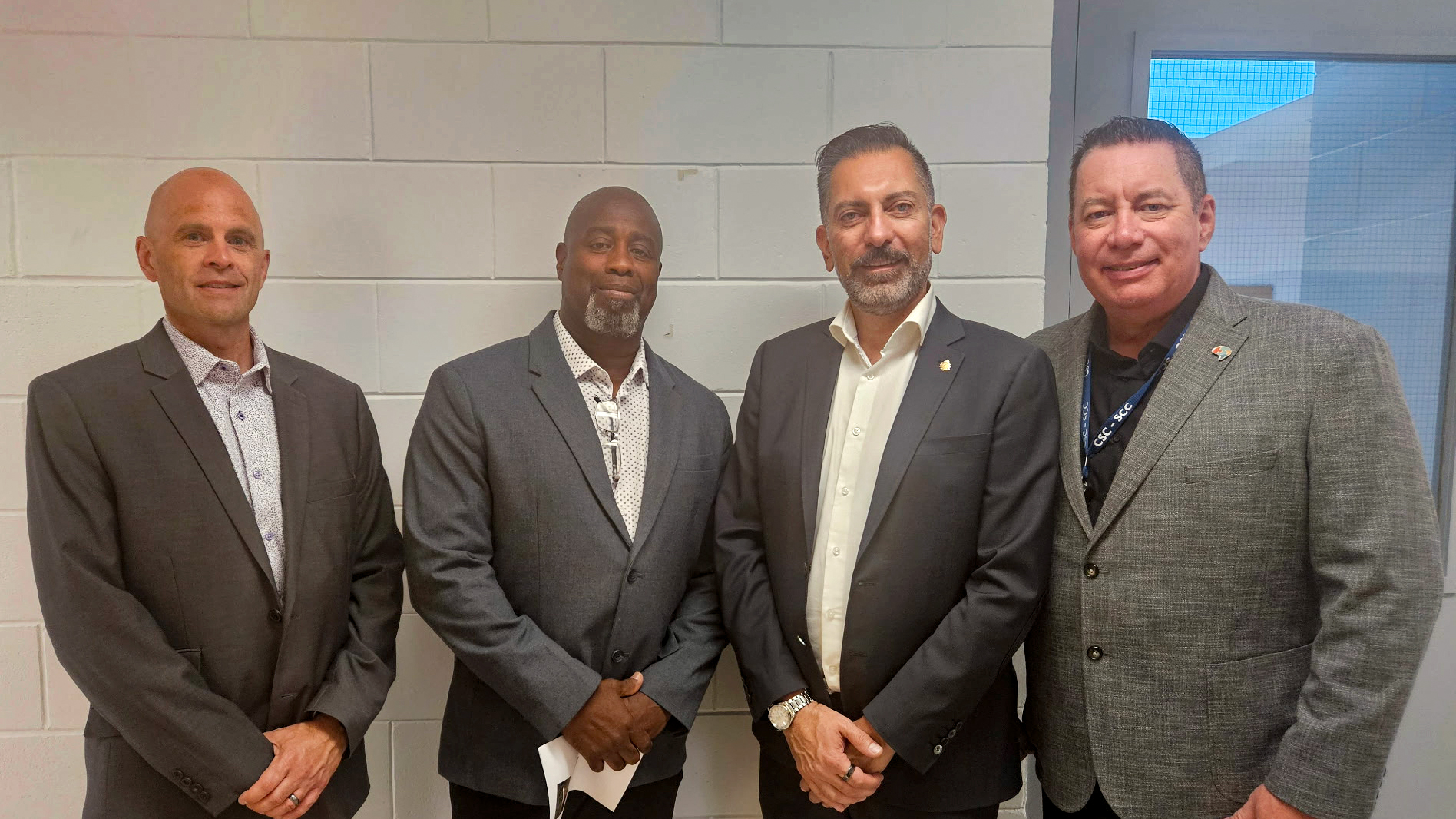
Commissioner Dakalbab is currently traveling across the country to meet with CSC management, employees and stakeholders to better understand the working environment at various CSC sites and the challenges faced by frontline staff.
On this date, the Commissioner visited both the Winnipeg Area Parole Office and Stony Mountain Institution (medium and maximum security).
The day started with a visit at the Winnipeg Parole Office where the Commissioner was greeted by District Management, many office staff and USJE National President Neufeld and RVP Sandelli. The Commissioner invited frontline staff to share with him details regarding their workplace conditions/experiences and any challenges they may be facing in their daily work.
USJE members expressed a great deal of appreciation for their local management team and described the positive relationship they have working with them. Some members were quick to identify how the changes made in CD 715 and CD 715-1 in May 2026 were negatively impacting their work and the level of discretion that was removed in managing the supervision of their offenders in the community (ie. related to the approval of travel permits for Indigenous offenders attending cultural activities).
USJE members also spoke to the following challenges: high workloads; high employee turnover; the amount of time it takes to complete staffing actions; the high number of acting and term positions; the increase of virtual CSC training versus having face-to-face CSC training; the rigidity of the Integrated Correctional Program model; the need for CSC staff to tailor programming to the needs of offenders; the recertification process for Correctional Program Officers; the lack of access to Elders in the Community; the language barriers experienced when working with Indigenous offenders; and the need for greater mental health supports for staff.
USJE members did identify that local management was very good at checking in with staff when they were experiencing operational stress but that the high level of workloads and the complexity of the cases assigned to them contribute to high rates of burnout and the need for more staff.
There was an acknowledgement by the Commissioner of USJE’s Correctional Program Officer Report (released in March 2026) and the fact that CSC will be reviewing the recommendations carefully. At one point, the discussion also focused on the value of the work of CR-04s in the office and the integral role they play in case management. President Neufeld then shared with the group some details regarding USJE’s “CR-03/CR-04 Campaign” and how USJE is currently advocating for better working conditions and wages for these specific occupational groups.
The frontline staff made some strong recommendations to the Commissioner around the need for CSC to “invest in the staff” and to provide “greater discretion” to the frontline when it comes to implementing national policies. The Commissioner was very appreciative of the comments and feedback from the frontline staff at Winnipeg Parole.
In the afternoon, President Neufeld, and RVPs McIntosh and Sandelli, met with the Commissioner and RDC Prairies at Stony Mountain Institution. The visit began with a small roundtable discussion with Acting Warden, Kerri Emms, USJE Local President Carlos Portillo and two other bargaining agent representatives. The union representatives spent some time speaking to the Commissioner on the negative effects of the Comprehensive Expenditure Review (CER) and how they were impacting security of the institution and the staff.
The USJE representatives then participated in an Elder Feast with the Commissioner that was put on by the Elders of SMI and the Institutional staff from Indigenous Initiatives. The Feast was very much appreciated by all in attendance.
After the Feast, the USJE representatives participated in a site tour provided by SMI management. This tour included stops in Unit 1, the Ni-Mikana Unit (healing unit for Indigenous inmates), the SIU, the Maximum Security Unit, the recreational areas, CORCAN Industries, the education and library areas and the kitchen. USJE members were engaged with the Commissioner and were able to speak about the work in their area of the institution. Some issues raised centered on high workloads and other institutional operational stresses.
The USJE representatives appreciated the Commissioner’s desire to hear directly from members across the institution and his willingness to understand the working conditions that they are currently facing.
USJE wishes to thank the Commissioner Dakalbab for his willingness to conduct these site visits with members of USJE’s National Executive and his invitation to participate in future similar visits. It is hoped that USJE members will continue to share their workplace realities with the Commissioner during his site visits in the coming months in order to help shape the priorities for CSC moving forward.