
In early November 2025, the government tabled its first budget which included provisions to manage workforce reductions and streamline operations within the federal public service. Among those provisions is the Early Retirement Incentive (ERI) program.
Despite the budget not yet having received Royal Assent, in December 2025, the Treasury Board of Canada issued over 70, 000 notices to federal public service workers advising that they may be eligible for the ERI. In essence, the communication was, at best, a letter of nothing and an offer of maybe. The intent, we can only assume, is to encourage hard working individuals to leave the public service earlier than anticipated with nothing more than the pension amounts they have already earned.
Here is what we know about the ERI program:
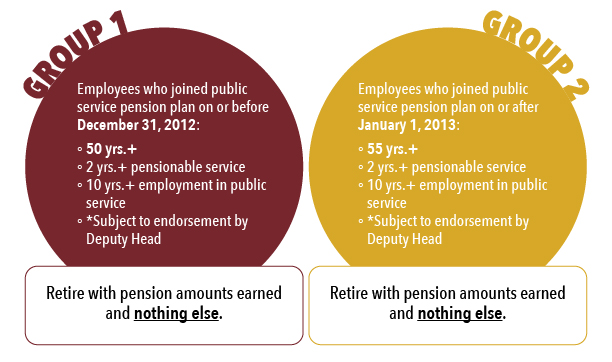
In addition to the above, the notices impose tight time constraints on individuals who are being asked to make an important life decision. Specifically, the government’s intention is to:
- Roll-out the ERI once legislation comes into force;
- Eligible employees will have 120 days to decide whether to retire early;
- Retirement must occur within 300 days of legislation coming into force;
- *NOTE: A decision to retire is non-revocable (employees cannot change their mind once they have elected to retire)
What the budget and ERI fails to highlight is that the workforce adjustment (WFA) provisions that were painstakingly negotiated in our collective agreements already provide for a pension waiver (albeit the age requirement is higher than the ERI) PLUS additional financial benefits and supports to employees, as well as union oversight and better human resource management. Below is what a USJE member under the Public Service Superannuation Act could potentially receive under the WFA process:
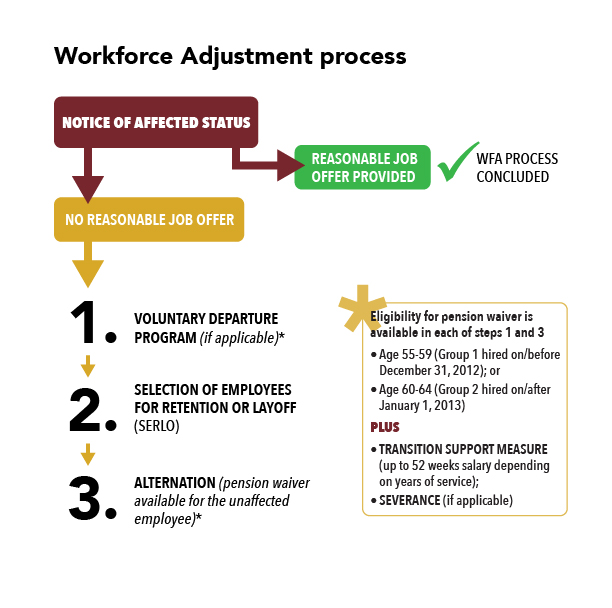
Since there is a pension waiver component considered in the WFA process, why is the employer introducing the ERI outside the WFA process and, more concerning, why are they so adamant that the ERI process is not a WFA exercise? The answer: to avoid paying the negotiated benefits (like the Transition Support Measure – a lump sum payment based on your years of service) and protections contained in our collective agreements and to capitalize on savings off the backs of hardworking and devoted federal public service workers.
In addition to speaking with your union representatives on collective agreement rights and entitlements, USJE strongly urges any member that is considering retirement (either through the ERI or other options) to contact the pension center to speak about their individual situation and to seek advice from a financial adviser before making any life-altering financial decisions.
While the government’s budget has left many with more questions than answers, one thing is certain – employees should be wary of the motives behind the ERI Program and question whether it is truly an incentive or, instead, a concession.