
National Equity Committee
The role of the National Equity Committee is to provide recommendations to the USJE National Executive in regards to:
- Ways the employer could better deal with equity issues in the workplace
- Ways that USJE could better deal with equity issues within USJE
If you would like to contact the USJE Equity Committee, please email us at: USJEEquity-EquiteSESJ@psac-afpc.com
Updates

National Indigenous Peoples Day: Decolonizing our union

Local President and Equity Committee member Satinder Bains talks to Regina—Qu’Appelle Conservative MP Andrew Scheer about inflation and collective bargaining

Equity Committee member Éric Villeneuve and Quebec REVP Alternate Annick Lamoureux meet MP Louise Chabot to talk about poor state of PA/UTE collective bargaining
Committee Members


Shauna Ward – Chair
Shauna Ward is the Regional Vice President CSC for the Prairies region. She has been the Chair of the Equity Committee since August 2023.
First elected to the position of RVP at the Triennial Convention in St-John’s in 2021, Shauna, along with National Vice-President Lynette Robinson, was instrumental in creating USJE’s first Equity Conference held in Winnipeg in February 2023.
Shauna started her career in Public Safety at the Women’s Jail at Portage la Prairie until 2009. She then worked at Stony Mountain Institution as a Correctional Officer and moved on to be an Indigenous Correctional Program Officer before transferring to Saskatchewan Penitentiary in Prince Albert.
Shauna continues to push forward USJE’s bold Equity agenda by being a tireless advocate for inclusion and consideration for all equity-deserving groups.
Shauna is a member of the Sandy Bay Ojibway First Nations. She is two-spirited and differently abled.
Videos
About Equity
What is employment equity?
Employment equity is a program of proactive, positive measures designed to:
1. Increase the representation of workers who have historically been disadvantaged in the workplace,
2. Identify and eliminate artificial barriers in the workplace that prevent equity group members from accessing jobs, promotions, training, etc.
Employment equity is the use of hiring policies that encourage fair representation of equity groups to a level that reflects their availability in the labour market. It’s about changing workplace culture and hiring practices so that members of these groups get jobs they are qualified to do.
Equally important is what happens after people are hired. Workplaces often have hidden bias or unnecessary barriers that create a negative environment for members of equity groups or prevent them from advancing in their careers on a fair and equal footing with other employees.
Who are the equity groups?
In the Employment Equity Act, the four designated groups are defined as:
- Women
- Indigenous people, whether First Nations, Métis or Inuit
- People with disabilities, which might be a physical, mental, sensory, psychiatric or learning impairment
- Racialized people
Why is equity important?
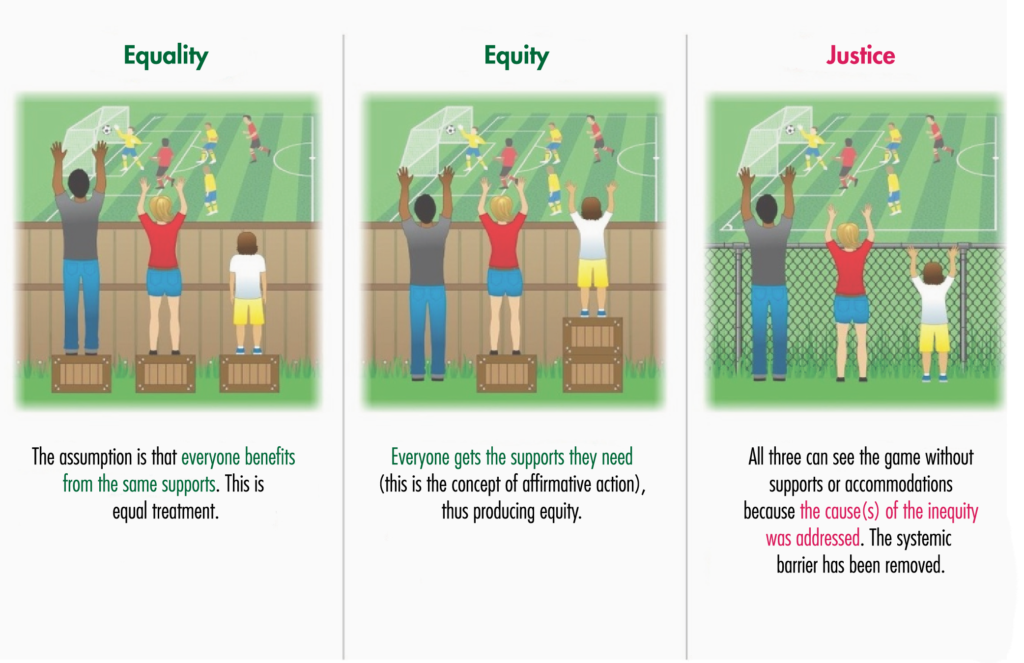
It’s about fairness. Employment equity recognizes that women, Indigenous people, racialized people, and people with disabilities are often held back—not because they lack ability—but because of things that are unrelated to their ability. Things like racism, discrimination, bias, stereotypes, assumptions, and systems that were not designed inclusively.
It’s about ensuring equal opportunity for all, by ensuring that hiring and promotion should be free from biases, favouritism, and prejudice, and that all workers should be recognized for their skills and abilities.
Discrimination is not always obvious and outright: sometimes it is embedded in our systems, practices, and policies. Employment equity is a proactive way of addressing systemic discrimination in the workplace.